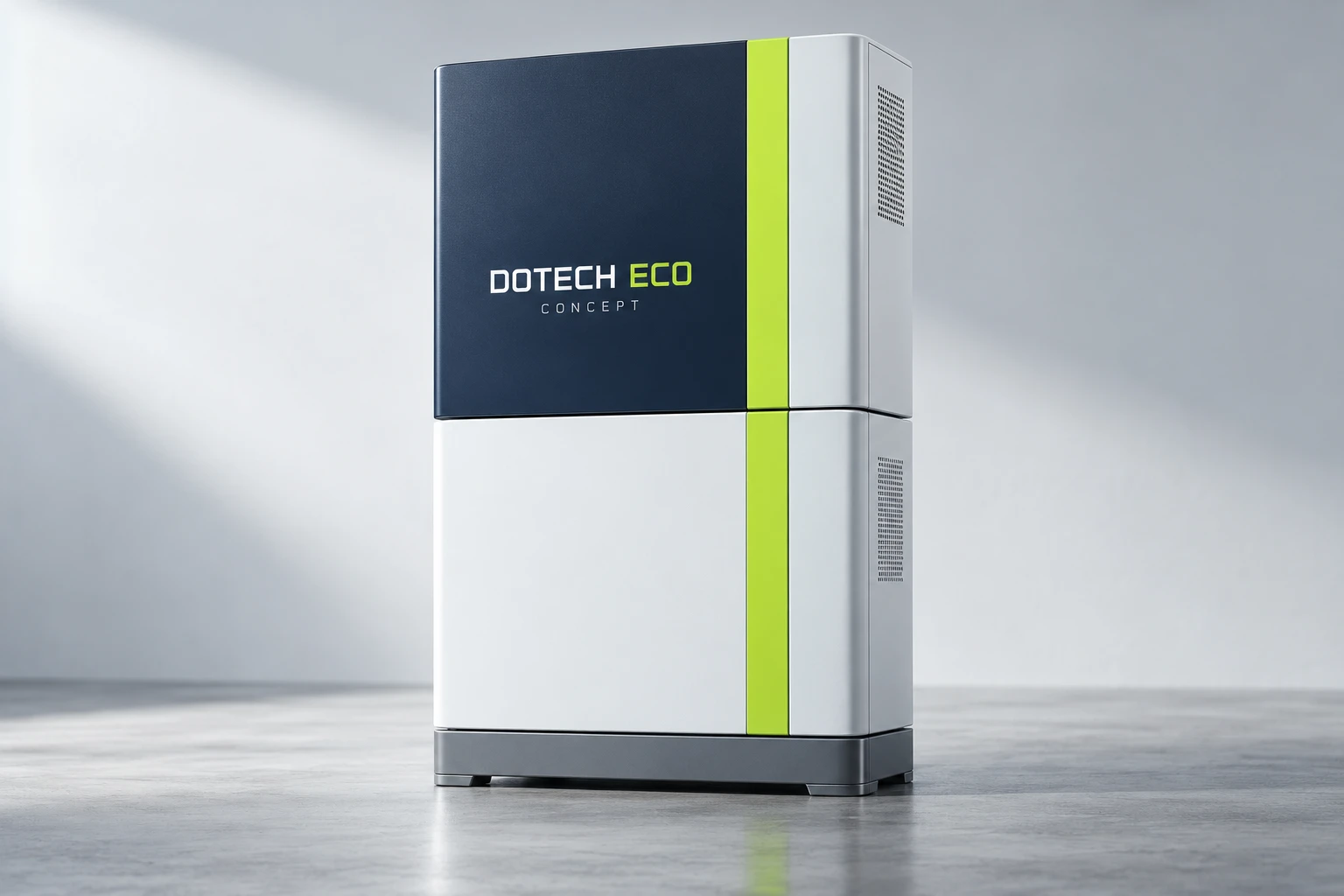
Wall-mounted home storage
A compact battery concept for selected residential circuits and solar energy storage.
Homes and villas; essential-load backup.

ENERGY STORAGE · DUBAI, UAE
Battery storage and system selection built around your loads, your site and your energy goals. Explore the possibilities with DOTECH ECO.
Final specifications depend on the project requirements. Availability and compatibility must be reviewed before approval.
DOTECH ECO / Storage, shaped around your project.
Explore product formats before choosing a capacity. Every configuration begins with an application and compatibility review.
A compact battery concept for selected residential circuits and solar energy storage.
Homes and villas; essential-load backup.
A cabinet concept that organises battery modules for commercial and industrial system planning.
Commercial facilities and selected industrial loads.
A coordinated battery-and-inverter concept for projects seeking a consolidated system layout.
Residential or light-commercial energy storage.
A solar-plus-storage concept for shifting available daytime energy to later use.
Solar-equipped homes, businesses and farms.
A storage concept for critical loads, remote sites and coordinated generator support.
Essential-load backup, farms and remote locations.
DOTECH ECO / What should your energy system solve?
Storage can address different needs. The value depends on how the system is designed and operated.
Plan a defined backup supply for essential circuits. Runtime and transfer behaviour depend on the approved equipment and load profile.
Store available solar generation for later demand. Battery storage does not create energy; it shifts when it can be used.
Assess whether scheduled charging and discharge could reduce peak demand or generator run time. Savings require a tariff and operating review.
DOTECH ECO / Different sites. Different priorities.
Begin with the loads that matter and the conditions in which they operate.
Essential lighting, refrigeration and connectivity may be prioritised. Air-conditioning loads require a separate assessment of running and starting power.
Map business-critical loads, operating hours and phase requirements. Production equipment and larger motors need specific power and protection studies.
Assess pumps, irrigation controls, lighting and available charging sources. Dust, heat and service access shape the enclosure and maintenance plan.
Define critical circuits and acceptable interruption times. A storage system is not automatically a UPS; life-safety and regulated loads require specialist review.
DOTECH ECO / Understand energy before choosing equipment.
A useful proposal separates stored energy from output power and makes every sizing assumption clear.
Kilowatt-hours describe stored or consumed energy. Usable battery energy can be lower than nominal capacity because of operating limits, reserves and conversion losses.
Kilowatts describe the rate of energy delivery. Check continuous output and brief surge demand separately; a large energy capacity does not guarantee sufficient starting power.
Lithium-ion is a family of chemistries. Lithium iron phosphate (LiFePO₄ / LFP) is one option considered for stationary storage. Chemistry alone does not establish system safety, lifetime or suitability.
Planning illustration, not a quotation or equipment recommendation. Assumptions are adjustable and are not DOTECH ECO product specifications. A technical review must also assess peak power, motor starting, reserve, temperature, ageing and inverter limits.
DOTECH ECO / Batteries are part of the system.
Energy sources, power conversion, storage and protection must work together. Compatibility is checked before equipment is approved.
The battery stores DC energy. The Battery Management System monitors cell voltage, current and temperature and coordinates protection within its configured limits.
An inverter converts DC to AC for compatible loads. Solar can charge storage through an approved AC- or DC-coupled arrangement; an existing solar system is not automatically battery-ready.
Review voltage, frequency, phase, export control, earthing, isolation and transfer arrangements. Generator charging and outage operation must be supported by the selected equipment.
DOTECH ECO / Product Visualization
Functional illustration only; it is not a wiring diagram. Coupling, isolation and transfer arrangements depend on the approved system design.
DOTECH ECO / A clear route from brief to proposal.
Our proposed assessment workflow defines the decisions and documents needed for a project-specific technical proposal. Delivery responsibilities are agreed in the project scope.
Identify backup, solar self-consumption, off-grid autonomy or another measurable requirement. Separate essential loads from optional loads.
Review operating hours, energy consumption, starting loads, available space, access and environmental conditions.
Compare battery format, usable energy, output power, inverter interfaces and available charging sources.
Review selected-equipment datasheets, protection settings, supporting documents and responsibilities before approval.
Define installation checks, operating instructions, handover documents and support arrangements in the agreed proposal.
DOTECH ECO / What we need for a useful technical proposal.
Share what is available. Missing information should be identified and resolved before final system selection.
Equipment ratings, typical operating hours, critical circuits, recent electricity bills and interval data where available.
Single-line diagram, supply voltage and phase, distribution information, and existing inverter, solar and generator model details.
Location, equipment area, wall or floor construction, cable routes, access, ventilation and expected environmental exposure.
Desired autonomy, acceptable transfer interruption, budget range, expansion plans, timeline and known authority or landlord requirements.
DOTECH ECO / Trust begins with evidence.
Quality should be supported by documentation for the selected equipment and agreed acceptance checks—not by unsupported badges or blanket assurances.
Request manufacturer datasheets, model identification, operating limits, traceability details and relevant test documentation. Certifications and approvals must match the actual model and market requirements.
Confirm overcharge and deep-discharge limits, current protection, temperature sensing, cell balancing and fault response where provided. BMS protection does not replace external electrical protection or sound system design.
Agree checks for installation, polarity, isolation, earthing, communications and operating modes by qualified personnel. Define any capacity or performance tests in the proposal.
DOTECH ECO / A suitable environment matters.
Installation conditions are part of selection, not an afterthought. Follow the selected manufacturer’s instructions and project requirements.
Check specified charge and discharge temperature limits, heat rejection and service clearances. Cooling or a conditioned equipment area may be needed; suitability for UAE heat is not assumed.
Check humidity limits, condensation risk, dust exposure and the confirmed enclosure rating. Do not assume that an indoor concept is approved for outdoor installation.
Review wall or floor loading, cable routing, safe access, isolation and required fire or electrical provisions with the responsible project professionals.
DOTECH ECO / Support with a defined scope.
Ask for a support plan appropriate to the selected equipment. Response times, warranty coverage and service responsibilities are confirmed in the commercial proposal.
Discuss loads, proposed configuration and available documentation. Record questions and unresolved compatibility requirements.
Define the documents to be supplied: equipment schedules, operating instructions, agreed test records and contact routes.
Establish how faults, operating alerts and maintenance questions are reported. Remote monitoring and software access depend on the selected configuration.
DOTECH ECO / Good questions lead to better decisions.
Practical answers to help frame your project brief. Final suitability is confirmed through technical review.
List the loads, estimate their average power and required runtime, then account for usable battery capacity, conversion losses and reserve. Assess peak power and motor starting separately. A site-specific review is needed before choosing equipment.
kWh is a quantity of energy; kW is power at a moment in time. A 2 kW average load operating for 3 hours uses 6 kWh before system losses. This is an educational example, not a product specification.
Only if the system is designed and approved for those loads. Essential-load backup may be more appropriate than whole-building backup. Phase arrangement, peak demand and available inverter output must be reviewed.
Potentially, but the existing inverter, coupling method, controls and electrical arrangement must be reviewed. Solar generation and battery storage do not automatically provide outage backup.
Available according to the selected configuration. Review voltage, phase, charging controls, transfer equipment and generator interface before approval. Grid requirements and project approvals remain separate checks.
A BMS monitors the battery and manages protection within its programmed limits. Review cell voltage, temperature, current limits, balancing, communication and fault handling for the selected model. It does not eliminate all battery risks.
Configured BMS limits and compatible charging equipment help manage these conditions. External protection and correct commissioning are also necessary. Exact thresholds must be confirmed in the technical proposal.
Outdoor use is not assumed. The confirmed enclosure rating, operating limits, humidity, condensation, shading and cooling requirements must match the site. Final conditions depend on the selected equipment.
These are not yet confirmed for the concept range. Request model-specific supplier evidence and written commercial terms. Cycle life depends on test conditions and use; a cycle figure is not a warranty.
Expansion depends on the manufacturer’s approved module combinations, voltage, firmware, communications and installation space. Mixing batteries or adding modules is not automatically supported.
It may help in suitable conditions, but savings depend on tariffs, load timing, solar generation, losses and system cost. A financial assessment should accompany the technical selection; no savings percentage is promised.
Send a load list, required runtime, electricity records, site photographs and any electrical drawings or existing equipment model details. The proposal should identify missing information and all assumptions.
DOTECH ECO / Contact
Tell us which loads you want to support, your site location and your target backup duration. We can use these details to discuss a suitable next step.